Construction Consulting as an Investor Protection Tool
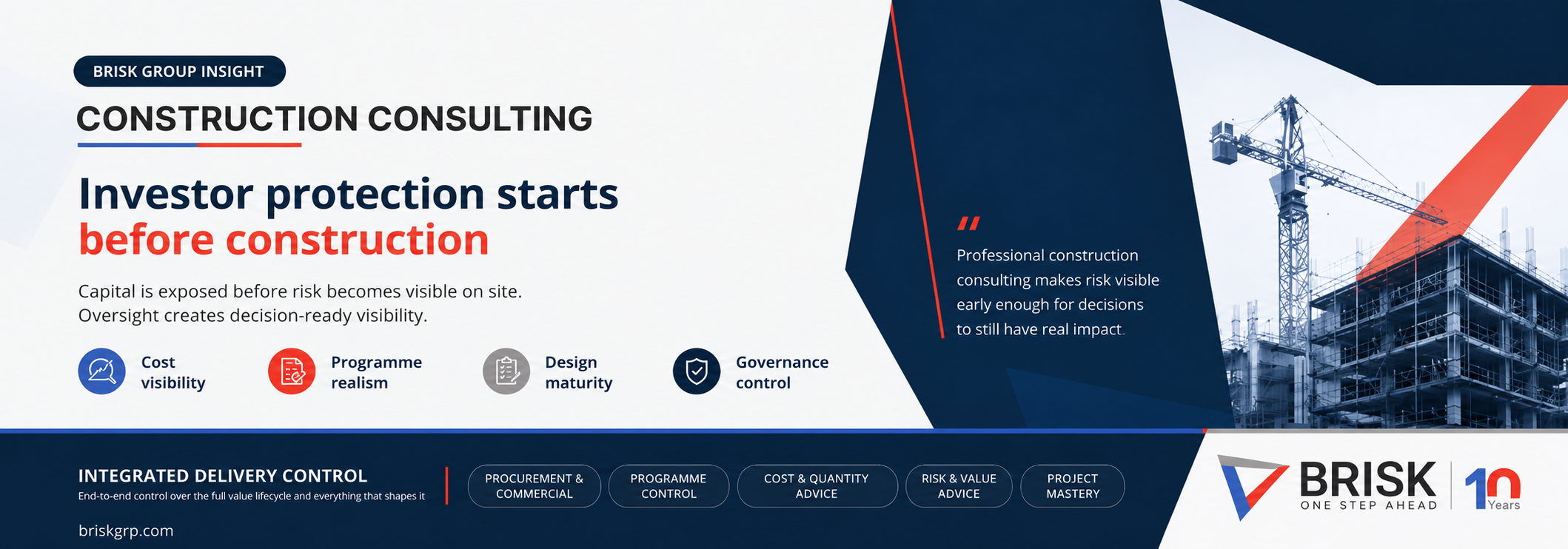
Construction consulting is increasingly becoming a strategic instrument for investor protection.
In real estate, infrastructure, industrial, logistics, healthcare and mixed-use developments, capital is exposed long before construction risk becomes visible on site. Cost assumptions, design maturity, procurement strategy, programme realism, contractual structure and governance quality all influence the financial profile of a project.
For developers, investors and lenders, the central question is no longer limited to whether a project can be built. The stronger question is whether the project can be delivered with sufficient visibility, discipline and control to protect value throughout the full project lifecycle.
This is where professional construction consulting becomes essential.
Why investor protection starts before construction
Many project risks are embedded early.
A weak brief can create design ambiguity. Incomplete design coordination can generate procurement uncertainty. Poor cost planning can create false confidence. Unrealistic schedules can compress delivery logic. Weak reporting can hide risk until corrective action becomes more expensive.
By the time these issues appear on site, they may already have affected cost certainty, programme reliability and stakeholder confidence.
Investor protection therefore starts before construction. It starts with structured project governance, disciplined project management in construction, robust cost management services, technical due diligence, development monitoring and integrated project controls.
The role of construction consulting is to make risk visible early enough for decisions to still have real impact.
Visibility over cost exposure
Cost visibility is one of the most important forms of investor protection.
A construction budget should provide more than a headline figure. It should show the assumptions behind the number, the maturity of the design, the strength of benchmarking, the level of contingency, the exposure to inflation, the procurement strategy and the potential cost-to-complete trajectory.
Professional cost management services help developers and investors understand whether the budget is realistic, current and aligned with project scope.
This includes cost planning, benchmarking, value engineering, procurement advice, change control, variation assessment, cost reporting and cost-to-complete forecasting.
In complex projects, cost pressure rarely appears as one isolated event. It develops through design changes, procurement assumptions, specification drift, market shifts, delayed decisions and weak change control. A strong cost management framework helps identify these signals early and supports better financial decisions.
Visibility over programme realism
Programme risk is another major area of capital exposure.
A schedule can appear attractive commercially while being fragile operationally. If design freeze dates, authority approvals, procurement lead times, long-lead items, site logistics, contractor mobilisation and construction sequencing are not properly tested, the programme may become a source of risk rather than control.
Planning and project controls help convert schedules into management tools.
They identify dependencies, critical paths, decision points, procurement constraints, design deliverables, reporting milestones and recovery scenarios. This gives investors and lenders a clearer understanding of whether the project timeline is credible.
Programme visibility protects value because time affects cost, financing, leasing, revenue, contractual exposure and market positioning.
Visibility over design maturity
Design maturity is directly connected to investor confidence.
When design information is incomplete or poorly coordinated, procurement becomes less reliable. Contractors price uncertainty, qualifications increase, exclusions multiply and tender comparison becomes weaker.
Strong design management helps protect the project from this risk.
It coordinates disciplines, manages deliverables, tracks open issues, supports technical reviews and links design decisions to cost, programme, procurement and risk impact.
For investors, this matters because design quality is not only an architectural issue. It affects budget reliability, construction sequencing, permitting, sustainability performance, tenant requirements, operational efficiency and long-term asset value.
A mature design process creates stronger conditions for predictable delivery.
Visibility over procurement and contractual risk
Procurement is a decisive moment in project governance.
A project that enters the market with unclear scope, incomplete information or unresolved technical interfaces transfers uncertainty to contractors and suppliers. That uncertainty returns through higher pricing, exclusions, claims exposure or weaker competition.
Professional construction consulting supports procurement readiness by testing scope clarity, package strategy, market capacity, contractor appetite, commercial assumptions and risk allocation.
This is particularly important in capital-intensive developments where procurement decisions can shape the financial outcome of the project for years.
Investor protection requires procurement discipline. The objective is to enter the market with enough clarity to obtain comparable tenders, realistic pricing and a stronger contractual foundation.
Technical due diligence and development monitoring
Technical due diligence and development monitoring are increasingly important for investors and lenders.
Technical due diligence helps assess the project before capital is committed or before major decisions are taken. It reviews technical risks, design assumptions, approvals, cost exposure, programme feasibility, procurement strategy, site constraints and delivery readiness.
Development monitoring supports oversight during delivery. It provides independent visibility over progress, cost, programme, risk, quality, change control and compliance with agreed project parameters.
This independent perspective is valuable because capital providers need reliable information. They need to understand whether the project is progressing in line with expectations, where risk is increasing and what decisions may be required.
In this context, construction consulting becomes a value protection mechanism.
Governance as a financial discipline
Governance is often treated as an administrative layer. In complex construction projects, governance is a financial discipline.
It defines how decisions are made, how risks are escalated, how cost impact is assessed, how change is controlled, how reporting is structured and how accountability is maintained.
Weak governance allows risk to move through the project without being properly measured. Strong governance creates the conditions for timely decisions, transparent reporting and coordinated delivery.
For developers, governance protects delivery strategy.
For investors, it protects capital exposure.
For lenders, it strengthens confidence in project monitoring.
For project teams, it improves execution discipline.
How Brisk Group supports investor protection
At Brisk Group, construction consulting is approached through integrated delivery control.
Our services include project management in construction, construction management services, cost management services, design management, planning and project controls, technical due diligence, development monitoring and risk management.
This integrated structure allows us to assess projects across the full delivery chain: design, cost, programme, procurement, risk, site execution and reporting.
A cost issue may originate in design.
A programme issue may originate in procurement.
A risk issue may originate in governance.
A site issue may originate in an unresolved decision made months earlier.
This is why investor protection requires a connected view of the project.
Brisk Group supports clients by creating clearer visibility, stronger reporting, disciplined cost control, better risk management and structured decision-making across complex real estate and construction projects.
Conclusion
Construction consulting is becoming central to investor protection because delivery risk has direct financial consequences.
In a market where capital is more selective, financing is more sensitive and execution risk is under greater scrutiny, developers, investors and lenders need more than technical coordination. They need independent oversight, cost visibility, programme realism, design maturity, risk governance and transparent reporting.
The purpose of professional construction consulting is to protect value before value is exposed.
Strong projects are built on clarity, discipline and control.
In complex construction and real estate developments, investor protection starts with better project governance.