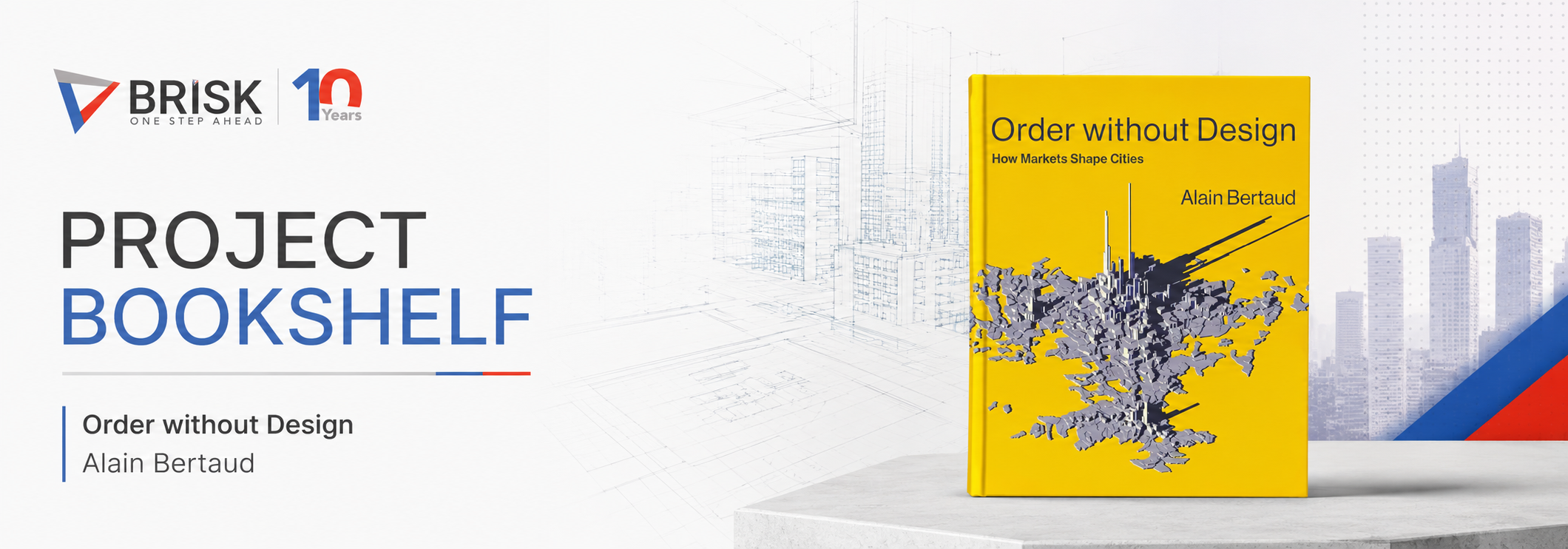
Project Bookshelf Review: Order without Design: How Markets Shape Cities by Alain Bertaud
Cities are often discussed through architecture, planning, identity and public space. Alain Bertaud, in Order without Design: How Markets Shape Cities, takes a more uncomfortable and useful route. He looks at cities as economic systems.
His central argument is direct: cities are shaped by markets, mobility, land use, regulation and the daily decisions of households, companies, investors and public authorities. Urban form emerges from this interaction. Plans matter. Design matters. Public policy matters. Yet none of them can fully control a city’s evolution without understanding the economic forces beneath it.
This makes the book particularly relevant for anyone involved in real estate development, infrastructure, project management or urban investment. Bertaud’s work forces the reader to look beyond drawings, zoning plans and architectural intention. It asks a more disciplined question: how does the city actually function?
For Brisk Group’s Project Bookshelf, this is precisely the kind of book worth reviewing. It connects urban theory with development risk. It explains why infrastructure, regulation, density, land values and mobility should be read together. It also reinforces a principle that is central to professional project management in construction: successful delivery begins with a realistic understanding of constraints.
The city as a market system
Bertaud treats the city as a labour market and a land market before anything else. People choose where to live based on access to jobs, cost of housing, commuting time, quality of life and available infrastructure. Companies choose locations based on labour access, logistics, visibility, cost and regulatory conditions. Developers respond to demand, land availability, planning rules, financing conditions and expected returns.
This view may sound technical, but it is deeply practical.
A city’s form is never random. High land values, transport connections, zoning constraints and household income all leave visible marks on the urban fabric. Densities rise or fall for reasons. Peripheries expand for reasons. Congestion appears for reasons. Housing affordability deteriorates for reasons. Real estate opportunities emerge where access, regulation and demand align.
For developers and investors, this matters because every project sits inside a larger urban equation. A residential scheme, logistics park, office building, retail development or mixed-use asset is affected by forces beyond its plot boundary. Access roads, utilities, public transport, permitting timelines, labour availability, financing costs and surrounding land uses all influence value.
This is where urban economics becomes highly relevant to project delivery. The physical site is only one layer of the project. The wider city often determines its viability.
Regulation has a cost
One of the strongest ideas in Bertaud’s book is that regulation always produces consequences. Planning rules can protect quality, safety, heritage and public interest. They can also restrict supply, increase land prices, reduce affordability, distort density and push development into inefficient locations.
This is a particularly important point for markets where planning processes are slow, fragmented or unpredictable. In such environments, development risk increases before construction even starts. Delays in approvals, unclear zoning, weak infrastructure coordination or inconsistent institutional responses can affect feasibility, financing and investor confidence.
Bertaud does not argue for the absence of regulation. His argument is more serious: regulation should be assessed by its measurable urban effects. Does it improve access? Does it support efficient land use? Does it allow housing supply to respond to demand? Does it reduce unnecessary friction? Does it create a clearer development framework?
For a construction consultancy, this logic is highly relevant. Cost certainty cannot be separated from planning certainty. Programme realism cannot be separated from permitting risk. Construction management services cannot compensate for every structural weakness created upstream, although they can reduce exposure once the project moves into delivery.
This is why early-stage advisory, project controls and cost management services are increasingly important in complex urban markets. The earlier risks are mapped, the better the project can be structured.
Mobility as economic infrastructure
Bertaud places major emphasis on mobility. In his view, transport is not simply a public service or an infrastructure category. It is one of the mechanisms through which the city’s labour market functions.
When people can reach jobs efficiently, the city becomes more productive. When transport systems are weak, fragmented or poorly integrated with land use, urban opportunity becomes uneven. Housing may appear cheaper at the periphery, but the real cost is often transferred into time, congestion and reduced access.
This is highly relevant for Bucharest, Ilfov and many fast-growing urban areas in Central and Eastern Europe. Residential expansion, retail development, logistics growth and infrastructure capacity are deeply connected. A development may be commercially attractive on paper and operationally vulnerable in practice if access, traffic, utilities and public infrastructure are underestimated.
Bertaud’s framework encourages developers and consultants to treat mobility as a value driver. It affects absorption, pricing, tenant demand, user experience and long-term asset resilience.
For Brisk Group, this connects directly with the need for integrated project management in construction. A project should be read through programme, cost, design maturity, infrastructure dependency and stakeholder complexity. The built asset cannot be assessed in isolation from the systems that support it.
Why this book matters for developers and investors
The practical value of Order without Design lies in the discipline it brings to decision-making. It encourages professionals to look at cities through evidence rather than preference.
For developers, the book is a reminder that demand is spatial. People do not simply buy square metres. They buy access, time, convenience, identity, safety, services and future optionality. For investors, it reinforces the need to understand how regulation, infrastructure and land supply influence long-term value. For public authorities, it offers a warning against planning systems that ignore market behaviour.
In development terms, Bertaud’s book helps clarify several questions:
How does accessibility affect value?
How do planning rules influence supply?
How does infrastructure shape density?
How does land scarcity affect affordability?
How do transport systems expand or limit opportunity?
How do regulatory delays translate into financing and delivery risk?
These are strategic questions. They sit upstream from design, procurement and construction. Yet they influence all of them.
A well-managed project requires more than technical coordination. It requires a clear understanding of the urban context in which the project exists. This is where project management, cost planning, development monitoring and construction oversight become part of a broader value-protection framework.
Relevance for Romania and regional markets
The book is especially relevant for Romania and the wider CEE region, where cities continue to experience pressure from demographic movement, infrastructure gaps, uneven planning capacity and changing investor expectations.
Bucharest and Ilfov are obvious examples. Residential demand, peripheral expansion, traffic congestion, retail development, logistics corridors and infrastructure delivery are all part of the same urban system. Treating them separately creates poor decisions. Reading them together creates better investment discipline.
Romanian real estate is increasingly shaped by selectivity. Financing conditions are tighter. Construction costs require closer control. Planning delays carry greater consequences. Investors are more sensitive to execution risk. In this environment, Bertaud’s message becomes highly practical: the quality of urban decision-making directly affects project viability.
For developers, this means that site selection, planning risk, access, utilities, phasing and cost exposure must be assessed with greater rigour. For lenders, it reinforces the importance of development monitoring and independent oversight. For public authorities, it underlines the economic cost of slow or inconsistent urban governance.
The book also supports a wider conversation about professionalisation in the construction and real estate sector. As projects become more complex, the market requires better governance, stronger cost controls and more realistic programmes. This is where project management in construction becomes a strategic function rather than a purely administrative one.
A Brisk Group reading
From Brisk Group’s perspective, Order without Design is valuable because it strengthens a clear professional argument: buildings are delivered on sites, but projects are shaped by systems.
A project is affected by the city around it. It depends on approvals, infrastructure, market timing, procurement conditions, utilities, traffic, cost inflation, design maturity and stakeholder decisions. The visible construction phase is only the final expression of a much longer chain of risks and decisions.
This is why independent project management, cost management services and construction management services matter. They create visibility across complexity. They help clients understand where risks sit, how decisions affect value and where intervention is needed before problems become expensive.
Bertaud’s book does not offer a design manifesto. It offers a method of seeing. It encourages investors, developers and consultants to understand cities as dynamic systems governed by incentives, constraints and movement.
For a market that increasingly demands predictability, this is a useful discipline.
Final thought
Order without Design is an important book because it challenges the instinct to see cities as static objects. Cities are constantly adjusting. Land values move. People relocate. Infrastructure opens new opportunities. Regulation creates incentives. Markets react. Projects succeed when they understand these forces early enough.
For built environment professionals, the lesson is clear. Urban development requires more than ambition and design quality. It requires disciplined reading of context, risk, cost, access and long-term value.
That is where the strongest projects begi