
A Budget Is Not a Strategy: What Richard Rumelt's Good Strategy / Bad Strategy Teaches Developers and Project Leaders
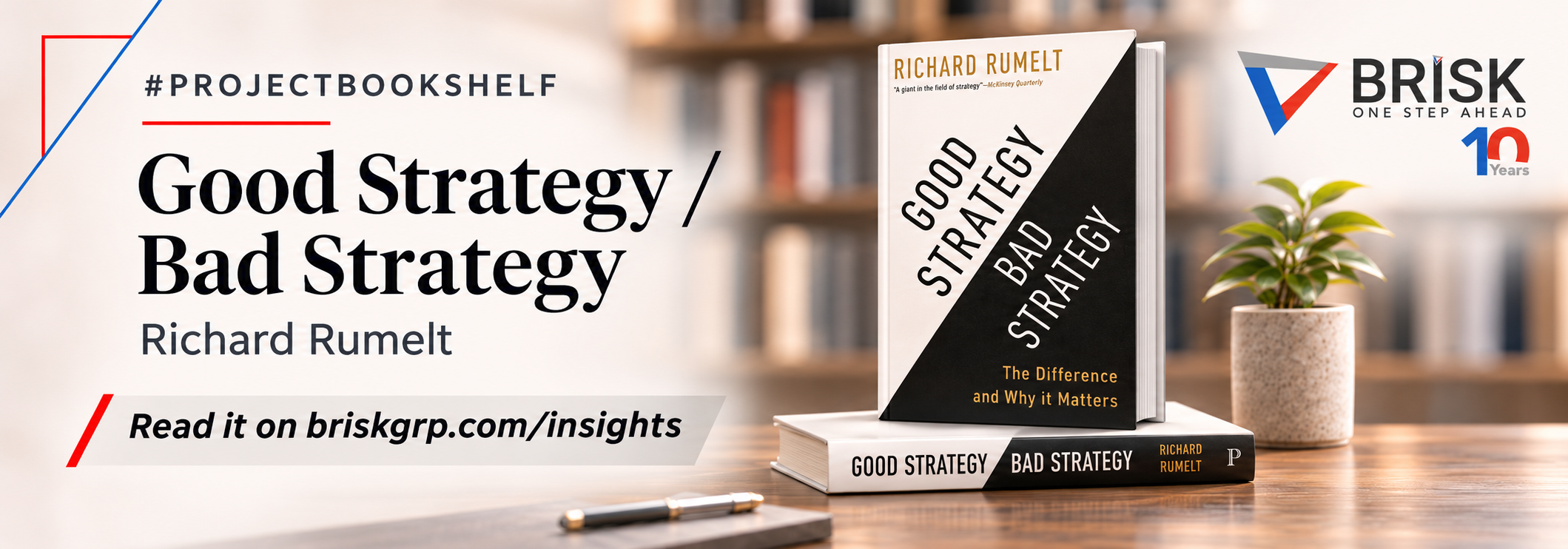
#ProjectBookshelf · A Brisk Group review
Every November, development pipelines for the coming year get their strategy documents. Most of them contain a target area, a target cost per square metre, a delivery date, a sustainability certification and a sentence about "creating a landmark destination". Richard Rumelt has a name for this. He calls it bad strategy, and he wrote the definitive book on why it fails.
Good Strategy / Bad Strategy (2011) is the standard text on strategy in business schools and one of the least-read books in the construction and property industry. That gap is an opportunity. At Brisk Group, we have delivered project management in construction for ten years, across more than 700 projects, and the single most expensive pattern we see is a project that was delivered well against a brief that was never a strategy.
What Good Strategy / Bad Strategy is about
Rumelt's argument begins with a diagnosis of his own: most of what organisations call strategy is not strategy at all. He identifies four hallmarks of bad strategy. Fluff, language that sounds strategic and says nothing. Failure to face the challenge, where the document never names the actual obstacle. Mistaking goals for strategy, where ambition replaces analysis. And bad strategic objectives, a long list of wishes with no priority among them, which Rumelt memorably calls a dog's dinner of goals.
Good strategy, by contrast, has a structure he calls the kernel:
- A diagnosis that defines the nature of the challenge. A good diagnosis simplifies an overwhelming situation by identifying which aspects are critical.
- A guiding policy, the overall approach chosen to deal with the obstacles identified in the diagnosis.
- A set of coherent actions that carry out the guiding policy, co-ordinated with one another so that they reinforce rather than compete.
The rest of the book explores the sources of power a good strategy draws on: leverage, proximate objectives, chain-link systems, design, focus, and the exploitation of inertia and entropy in competitors. Rumelt's examples range from Hannibal at Cannae to Apple in 1997, when Steve Jobs cut the product line to four machines and refused to answer the question "what is your strategy?" with anything other than "we are going to wait for the next big thing". That answer was a diagnosis, a guiding policy and a coherent action in one sentence.
The kernel, translated to a development project
Diagnosis: what problem is this building solving?A brief that says "15,000 square metres of Class A office space with LEED Gold" is not a diagnosis. The diagnosis is the answer to a harder question: what does this location, this market and this tenant pool need in 2027 and 2037 that the current stock does not provide? Technical due diligence, market analysis and the feasibility stage exist to produce exactly this. When they are skipped or compressed, the project carries an undiagnosed problem through design, tender and construction, where it surfaces as a change order.
Guiding policy: the product decision.Once the diagnosis is honest, the guiding policy follows. Build to core and hold, or build to sell. Large floorplates for a single anchor tenant, or divisible floors for flexibility. Spend on the envelope and the lobby, or on building systems and operating cost. Each of these is a policy that excludes other policies, and that exclusion is the point. Rumelt's recurring theme is that strategy is about choosing what not to do. A brief that tries to be premium, cheap, fast, flexible and iconic at the same time has not chosen anything.
Coherent actions: the design brief, the procurement route, the programme.Coherence is where development projects most often fail. A guiding policy of operating-cost leadership paired with a procurement route that selects the lowest capital bidder is incoherent. A policy of speed to market paired with a design freeze in month eleven is incoherent. Construction management services and cost management services are, at their best, coherence checks: they test whether the actions on the ground still carry out the policy on the paper.
Where the book maps onto project management standards
The APM Body of Knowledge structures a business case around five cases: strategic, economic, commercial, financial and management. Rumelt's kernel is the strategic case, written properly. The strategic case should contain the diagnosis and the guiding policy; the other four cases are the coherent actions that follow from it. The Body of Knowledge also observes that business cases are ultimately storytelling documents. Rumelt would agree, and would add that a story without a diagnosis is fluff.
The APM guide Doing the Right Project makes the same point from the systems-thinking side. Its central case study is a programme that was being delivered competently against a need that had moved, "a square peg into a round hole". The recovery began with a restatement of the business problem, after which, in the guide's words, many of the programme's problems simply dissolved. That is Rumelt's diagnosis step, performed late and at a cost. Performed early, it is called development strategy.
Two Rumelt ideas every project leader should keep
Proximate objectives. A good strategy sets objectives close enough to be achievable with the resources at hand, which then open the next objective. On a project, this is the difference between "deliver by Q4 2028" and "secure planning consent on the revised massing by March, which unlocks the lender's second tranche, which funds the tender". The first is a date. The second is a strategy.
Chain-link systems. Some systems are only as strong as their weakest link, and improving a strong link adds nothing. A building is a chain-link system. Excellent structural design contributes nothing to the tenant's experience if the mechanical systems are poorly commissioned. Rumelt's advice for chain-link systems is to fix the weakest link first, which is also the logic of integrated design management and of monitoring a project at its interfaces rather than at its headlines.
What we would push back on
Rumelt writes for corporate strategists, and some of his sources of power, such as exploiting a competitor's inertia, translate awkwardly to a single development. The book is also unapologetically Anglo-American in its examples, and its tone can be impatient with the organisational politics that project leaders cannot wish away. The APM short guide How to Manage Project Politics is a useful companion for the part Rumelt leaves out: how a sound kernel survives a steering committee.
None of that weakens the core. The kernel is the best three-part test we know for a development brief, and it takes one page.
The Brisk verdict
Read it before the first drawing. The previous books in this series were about delivering projects well: planning, forecasting, coordination, culture. Rumelt is about the step before all of them, choosing a project that deserves to be delivered. An owner-side consultancy earns its place at that step: technical due diligence is the diagnosis, development monitoring is the coherence check, and project management in construction is the discipline that keeps the actions aligned with the policy for three years and forty contractors.
A budget is a number. A deadline is a date. Neither is a strategy.
One step ahead, by design.
FAQ
What is Good Strategy / Bad Strategy about?Richard Rumelt's Good Strategy / Bad Strategy argues that most strategy documents are lists of goals and slogans, and that real strategy has a kernel of three elements: a diagnosis of the challenge, a guiding policy for addressing it, and a set of coherent actions that carry out the policy.
Why is Good Strategy / Bad Strategy relevant to construction and real estate development?Development briefs frequently state objectives (area, cost, date, certification) without a diagnosis of the market problem the building solves or a guiding product policy. Applying Rumelt's kernel at feasibility stage reduces late design changes, incoherent procurement decisions and change orders during construction.
What is the kernel of strategy according to Richard Rumelt?The kernel is diagnosis, guiding policy and coherent action. Diagnosis identifies the critical aspects of the challenge, the guiding policy sets the overall approach, and coherent actions are co-ordinated steps that implement the policy.
How does Rumelt's framework relate to a project business case?In the APM Body of Knowledge five-case model, Rumelt's diagnosis and guiding policy form the strategic case, while the economic, commercial, financial and management cases describe the coherent actions that follow from it.
What does Brisk Group do?Brisk Group is a project management and construction management consultancy founded in 2016, with offices in Bucharest, London and Chișinău. The firm delivers owner-side project management in construction, cost management services, construction management services, planning and project controls, design management, technical due diligence and development monitoring across Romania, the United Kingdom, Moldova and international markets, with more than 700 projects delivered.