Team of Teams by General Stanley McChrystal: What a Military Task Force Teaches Construction Project Management | #ProjectBookshelf
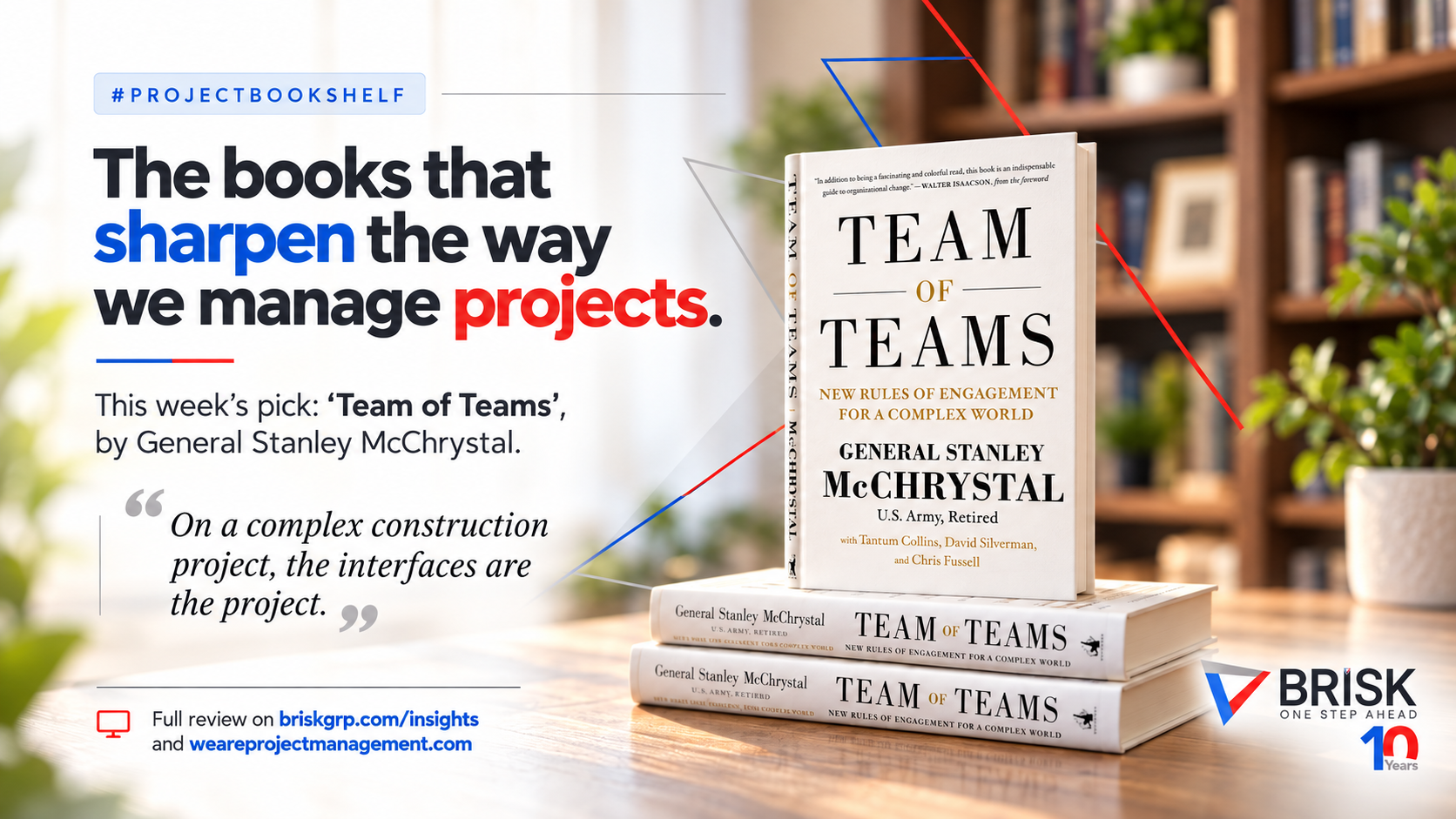
#ProjectBookshelf · A Brisk Group review
In 2004, General Stanley McChrystal commanded the best-resourced, best-trained special operations force in the world, and it was losing. Not to a superior enemy, but to a faster one. Al Qaeda in Iraq had no headquarters, no org chart and no approval chain. It shared information instantly and acted on it locally. The Task Force had every advantage except the one that mattered: speed of adaptation.
Team of Teams (2015) is the account of how McChrystal rebuilt that organisation, and it is the most precise description we have read of what goes wrong on large construction projects. Replace "Task Force" with "project organisation" and "intelligence" with "site information", and the diagnosis holds line by line.
At Brisk Group, we have spent ten years delivering project management in construction across Romania, the United Kingdom, Moldova and the Gulf. The pattern McChrystal describes is the pattern we are hired to resolve: dozens of excellent, specialised teams, each performing well inside its own boundary, while the project fails at the boundaries between them.
What Team of Teams is about
The book's central distinction is between complicated and complex. A complicated system has many parts, but the parts behave predictably; with enough expertise you can map it fully and plan it in advance. A jet engine is complicated. A complex system has parts that interact and change each other continuously, so the whole cannot be predicted from the parts. A city is complex. So is a war. So, McChrystal would argue, is any project with more than a handful of organisations on it.
The management tradition we inherited from Frederick Taylor was built for complicated problems: break the work down, specialise, optimise each piece, control from the top. McChrystal's argument is that this tradition is now actively harmful in complex environments, because it produces organisations that are efficient and blind. His answer has two halves, shared consciousness and empowered execution, and a new definition of leadership that makes both possible.
The four ideas, translated to the construction site
1. A building is complicated. A project is complex.The structure, the façade, the MEP systems: each is a complicated engineering problem with a correct answer. The project that delivers them is something else. Forty contractors, three design teams, a lender, an authority, a tenant whose requirements change in month nine, a steel price that moves in month eleven. No programme captures this fully in advance, which is why the discipline that matters is not the perfect plan but the organisation's ability to see and respond. Construction management services exist precisely for the complex layer, not the complicated one.
2. Shared consciousness: everyone sees the same picture, at the same time.McChrystal's most radical move was a daily operations and intelligence briefing open to 7,000 people across agencies and time zones. Counter-intuitive, expensive in hours, and transformational: for the first time, everyone understood the whole fight, not just their slice. On a construction project, shared consciousness has concrete forms: a single common data environment rather than six versions of the truth; integrated design and coordination meetings where the contractor hears the designer's reasoning directly; project monitoring reports that give the client, the lender and the delivery team the same numbers on the same day. Transparency is not a courtesy. It is the operating system.
3. Empowered execution: decisions are made where the information is.Once everyone could see the picture, McChrystal pushed decision authority down to the people closest to the action, and the organisation's tempo multiplied. The construction equivalent is a clear delegation of authority: which decisions the site team takes immediately, which go to the project manager within 24 hours, which require the client. Projects stall not because people lack competence but because approval chains were designed for a world where only the top could see. Hold points, change thresholds and a written authority matrix are not bureaucracy; they are what makes speed safe.
4. Liaisons, and the leader as gardener.Two smaller ideas carry much of the weight. First, embedded liaisons: McChrystal sent his best people, not his spare ones, to sit inside partner agencies, and the information flow changed overnight. On a project, the design manager who works physically with the contractor's team, or the cost manager who attends the contractor's own planning sessions, performs the same role. Second, "eyes on, hands off": the leader's job shifts from making every decision to cultivating the conditions in which good decisions get made. That is the honest job description of a project manager on a complex scheme.
Why interface management is where projects are won
The Association for Project Management's handbook Project Controls in the 21st Century defines an interface as a point where two things come together and affect each other, a two-way link that needs an active controlling party, typically the client organisation. Its case study is Crossrail, where civil works were delivered relatively well but the systems and supply-chain interfaces struggled to keep an integrated workforce aligned, and collaborative incentive frameworks were introduced only after the original delivery date had passed.
That is McChrystal's thesis in project-controls language. The silos performed. The seams did not. On a complex construction project, the interfaces are the project. An owner-side project manager who identifies, codes, schedules and actively manages every give-and-get milestone between parties is building shared consciousness, whether or not anyone on site has read the book.
What we would push back on
The military analogy has limits, and McChrystal acknowledges some of them. Construction runs on contracts, liability and regulated approvals; empowered execution cannot mean that a site engineer varies a FIDIC contract on instinct. The transferable principle is narrower and more useful: define in advance who may decide what, make the information available to them, and remove every approval step that exists only because the top of the hierarchy wants to feel informed. Empowerment inside a governance framework is not a contradiction. It is the design.
The book is also longer than its idea. The core argument sits in the first half; the second half illustrates it. Read it for the argument.
The Brisk verdict
Read it if your project has more organisations on it than any single person can hold in their head, which in 2026 means most of them. Team of Teams will not teach you to plan. Flyvbjerg and Tetlock do that, and we reviewed both. It teaches the other half: how to build a project organisation that notices reality before it becomes a claim.
The hardest interfaces on a project are rarely between structure and services. They are between teams that are each doing their job perfectly, in isolation. McChrystal's book is the manual for connecting them.
One step ahead, together.
FAQ
What is Team of Teams about?Team of Teams by General Stanley McChrystal explains how a hierarchical organisation can adapt to complex, fast-changing environments by building shared consciousness (transparent, real-time information across teams) and empowered execution (decision authority placed with the people closest to the information).
Why is Team of Teams relevant to construction project management?Large construction projects involve dozens of specialised organisations whose work interacts continuously. The book's framework maps directly onto interface management, common data environments, integrated coordination and delegated decision authority, which are the core disciplines of owner-side project management in construction.
What is the difference between complicated and complex in project management?A complicated problem has many parts but is predictable with enough expertise, like a structural design. A complex problem has interacting parts whose behaviour cannot be fully predicted in advance, like a multi-contractor construction programme. Complicated problems reward planning; complex problems reward adaptive organisation.
What does Brisk Group do?Brisk Group is a project management and construction management consultancy founded in 2016, with offices in Bucharest, London and Chișinău. The firm delivers owner-side project management, cost management, construction management, planning and project controls, design management, development monitoring and technical due diligence across Romania, the United Kingdom, Moldova and international markets.