Designing for the Next Tenant: How Buildings Learn by Stewart Brand
A developer approves a floor for a singletenant. Five years later, two smaller firms want to take it. On the leasingplan the change takes one line. On site it may take a second entrance, separatecontrols and a way to service one half while people work in the other. Much ofthe cost was settled years before either firm arrived.
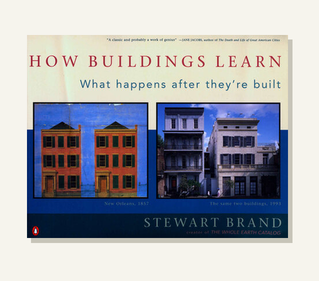
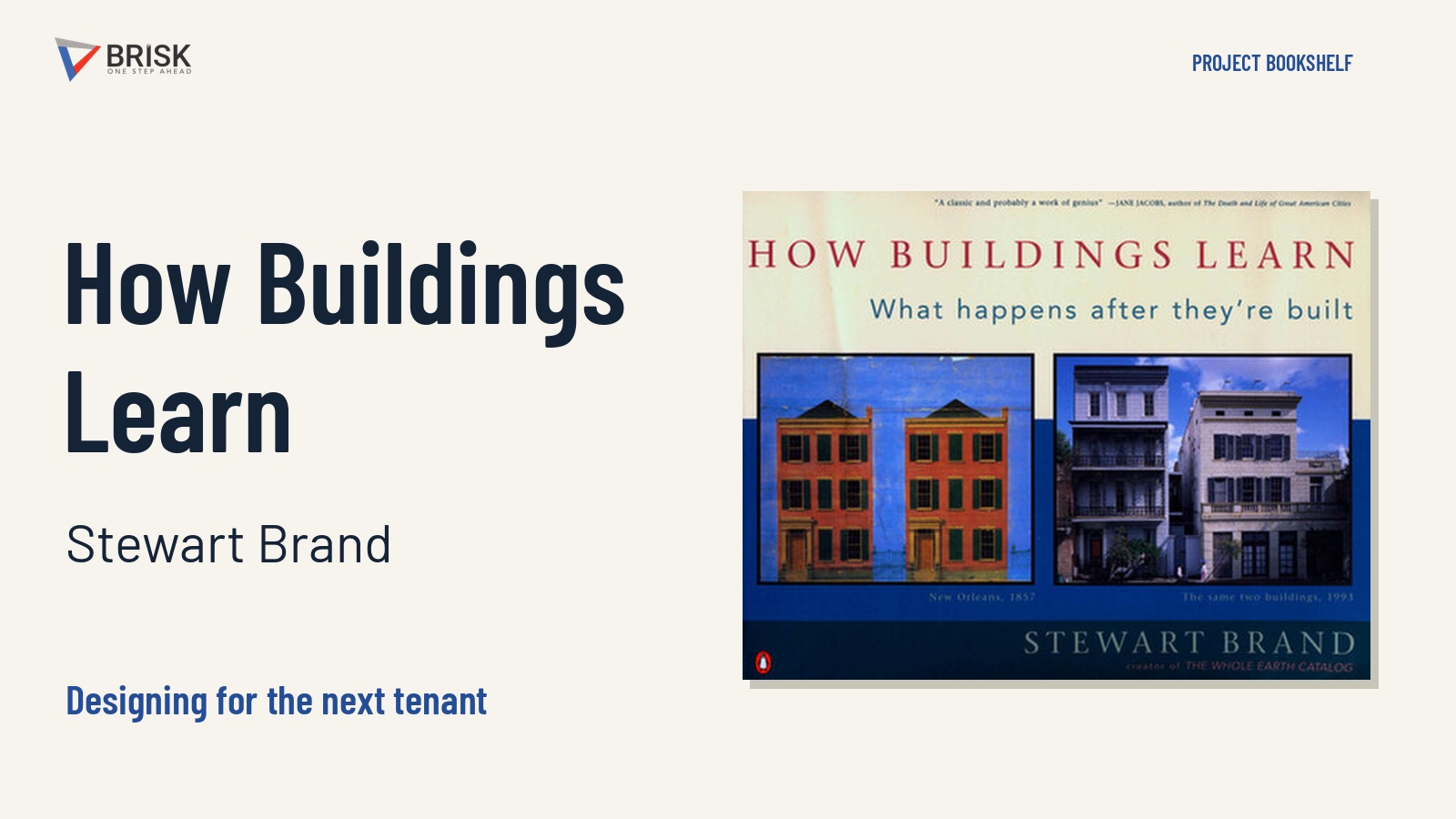
Stewart Brand’s How Buildings Learn: WhatHappens After They’re Built, first published in 1994, explains why. Brand pairsphotographs taken years apart and pays attention to the people who repair,occupy and alter buildings. His eye is drawn to the conversion, the extensionand the improvised fix. They tell us what the original brief missed, andsometimes what it wisely left open.
Six layers with different working lives
Building on architect Frank Duffy’s work,Brand distinguishes six layers: site, structure, skin, services, space plan andstuff. Walk through an office and the idea is immediately legible. Someone canmove a chair this afternoon. A tenant can rearrange meeting rooms betweenleases. Replacing the ventilation serving those rooms may require accessthrough an entirely different tenancy.
The insight lies in what happens where twolayers meet. If access to a short-lived component depends on dismantling along-lived one, the owner must pay for both interventions. Brand gives readersa vocabulary for spotting that dependency on a drawing.
Why an ordinary laboratory earns a chapter
One of the book’s most memorable examplesis MIT’s Building 20. Built as temporary wartime accommodation for radarresearch, it went on to house researchers across disciplines. Former occupantsrecalled how readily they could alter their surroundings, even routing a wirethrough a wall when an experiment called for it.
What stayed with us was who had permissionto shape the building. A researcher could discover a need on Tuesday and makespace for it on Wednesday. In a contemporary office the equivalent might be atenant able to divide a floor without asking the neighbour to close for a week.
The question for a Brisk design review
Brand makes a persuasive case for leavingroom to adapt. The harder commercial question is how much room an owner shouldbuy. A removable façade panel has an initial cost. Its value depends on theequipment behind it, the alternative access route and what it would mean tointerrupt operations.
At design review, we would put theoperator, the designer and the cost manager around the same drawing. Pick onepiece of plant likely to need replacement. Trace its route all the way out,including the turn beyond the plant-room door. Then price two credible optionsand record which disruption the owner is prepared to accept. That gives theoperator a decision they can recover years later, when the people who signedoff the drawing have moved on.
Read Brand before the next design freeze.Better still, lend the book to the person who will hold the keys afterwards.
Sources
Penguin Books ·https://www.penguinrandomhouse.com/books/320919/how-buildings-learn-by-stewart-brand/
Stewart Brand on the six layers ·https://stewartbrand.org/pace-layering-how-complex-systems-learn-and-keep-learning/
MIT Building 20 ·https://web.mit.edu/fnl/vol/104/Bldg20.html